
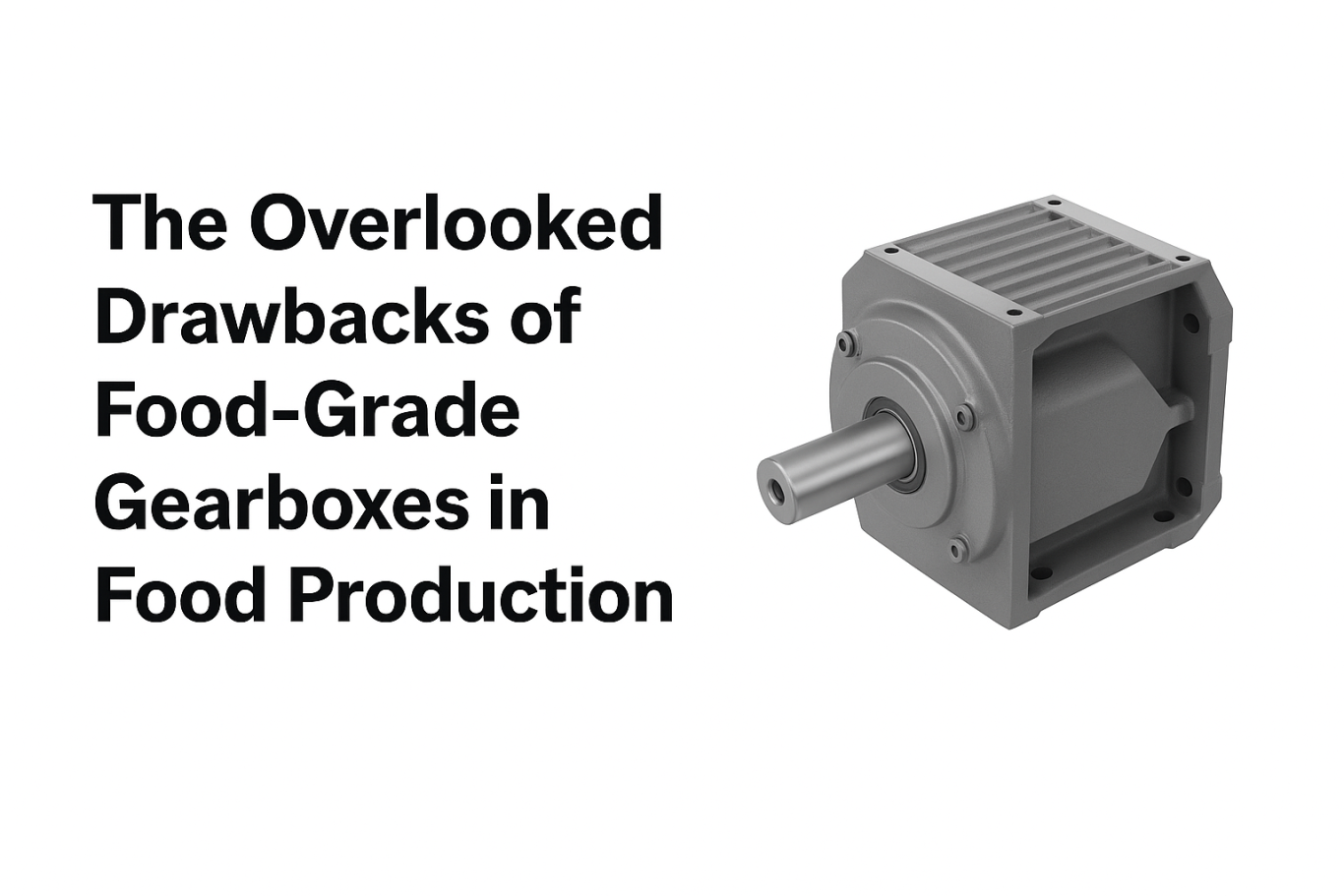
The Overlooked Drawbacks of Food‑Grade Gearboxes in Food Production
For decades, gear‑driven machinery has powered the core processes of food manufacturing. Conveyors, mixers, fillers, and packagers all rely on geared systems that require lubrication to operate. To minimize the risk of contaminating food, manufacturers have moved toward food‑grade oils and greases, combined with strict regulatory controls. These steps help, but they do not eliminate the inherent vulnerabilities of gearboxes in food environments.
Based on industry data, regulatory standards, and real contamination incidents, it is clear that lubricated gearboxes represent one of the most persistent and costly mechanical risks in food production. The following explores why.
Why Food‑Grade Lubricants Still Pose Risk
Food‑grade lubricants fall under three classifications: H1 (incidental contact allowed in very small amounts), H2 (no contact allowed), and H3 (edible oils used mainly for rust prevention). While H1 lubricants are formulated to be neutral in smell, color, and taste, they are not meant to be consumed. The allowance of less than 10 ppm is only an incidental tolerance, not an endorsement.
Regulations such as FDA 21 CFR Part 117 make it clear that machinery must be constructed and maintained to prevent lubricant migration into food. From a compliance standpoint, any detectable amount of non‑food‑grade lubricant in food is treated as adulteration. Even with H1 lubricants, visible droplets, films, or taste and odor issues make product unusable.
In other words, the presence of any lubricant in food is still a failure condition. The classification system merely defines degrees of regulatory consequence.
Food Safety and Health Concerns
Contamination remains the most serious issue with gearbox lubricants. A slow leak from a seal or a spray from a bearing failure can introduce grease, oil, and even metal wear particles into food. This can happen even in facilities that follow GMPs and use only approved oils.
The documented effects in real contamination events include throat irritation, a burning sensation, digestive discomfort, and noticeable off‑flavors or odors. In more severe cases involving non‑food‑grade lubricants, consumers have experienced acute reactions because of chemical additives not intended for ingestion.
Even when health impacts are mild, the product becomes unsellable simply due to quality defects like discoloration or oily films. Food safety programs such as HACCP recognize lubricants as chemical hazards for this reason.
Operational and Human Factors
Gearboxes introduce additional complexity to plant operations. Common operational impacts include:
- Slip hazards on floors from even minor leaks.
- Thermal or pressure‑related injury risks during failures.
- Additional PPE, procedures, and time required for maintenance.
- Opportunities for human error, such as mixing up lubricant types or over‑greasing equipment.
- Difficult cleaning processes when oil reaches enclosed or hard‑to‑sanitize areas.
When a leak occurs over or near product zones, production almost always stops immediately. Cleanup is rarely simple. Oil often requires solvents or special degreasers, and sanitation crews must remove guards and panels to fully access affected components.
This disruption is far greater than a typical mechanical breakdown because it carries both safety and regulatory implications.
Financial and Business Impacts
A single lubrication incident can create a chain of financial consequences far beyond the cost of repairs. These frequently include:
- Disposal of contaminated product, sometimes measured in tens or hundreds of thousands of pounds.
- Recall execution costs when contaminated goods reach distribution.
- Legal liability when downstream customers or consumers are affected.
- Increased insurance premiums.
- Lost productivity from downtime.
- Replacement of seals, gearboxes, or complete assemblies earlier than planned.
- Higher operating expenses due to the premium cost of food‑grade lubricants.
- Reputational damage that affects consumer confidence and long‑term sales.
Several notable incidents illustrate this clearly, including contamination events involving ham, sliced turkey, macaroni and cheese cups, and powdered milk. Some of these cases resulted in multi‑million‑dollar losses or lawsuits, even when consumer harm was minimal.
Proper vs Improper Use
Even when facilities use the correct lubricants and follow the right procedures, mechanical wear is inevitable. A gearbox seal will eventually fail. Bearings will expel excess grease if over‑pressurized. A filler cap may be left loose. A gearbox mounted above a product zone always carries a non‑zero risk of leakage.
Improper use dramatically amplifies these risks. This includes using the wrong lubricant grade, extending maintenance intervals too far, purchasing mis‑labeled lubricant, or ignoring early signs of leaks. Several major incidents over the past three decades stemmed from exactly these preventable errors.
The core issue, however, is that even perfect practices cannot eliminate the underlying hazard. Lubricated systems contain oil, and oil can escape.
Lessons from Real Incidents
Historically, lubricant contamination has affected nearly every category of food production. While many cases remain internal and unreported, the ones that do become public reveal consistent themes:
- Small failures escalate quickly.
- Contamination often reaches consumers before detection.
- The amount of affected product is typically large due to high line speeds.
- Companies often respond by revising equipment layouts or switching to different technologies.
These patterns show that the problem is systemic, not procedural.
The Industry Trend: Reducing or Eliminating Lubricants Near Food
Manufacturers are increasingly adopting a simple guiding principle: avoid the possibility of lubricant contamination altogether. Engineers and food safety teams describe this shift as a “zero lubricant on product” mindset.
This has accelerated interest in technologies that do not require traditional gearboxes, including direct drive systems and sealed‑for‑life power transmission solutions. These systems remove the oil reservoir, the seals, and the lubrication schedules from the equation. They represent a way to prevent contamination not through better discipline, but by eliminating the failure mode entirely.
Upfront investments in these technologies often pay for themselves by reducing maintenance, preventing unplanned downtime, and avoiding the high‑impact risks outlined earlier.
Closing Thoughts
Gearboxes with food‑grade lubricants have served the food industry well for many years, but their risks and costs are unavoidable. Even with improved lubricant formulations, stricter regulations, and disciplined maintenance programs, contamination events still occur and carry significant consequences.
As food safety expectations rise and operational efficiency becomes more critical, the case for moving away from lubricated gear systems continues to strengthen. Whether through direct drive technology or other innovations, the industry is moving toward solutions designed to eliminate lubricant‑related failures at the source.
This shift reflects a common goal shared across food manufacturing: protect consumers, safeguard brands, and maintain consistent, reliable production without the vulnerabilities that lubricated gearboxes inherently bring.