
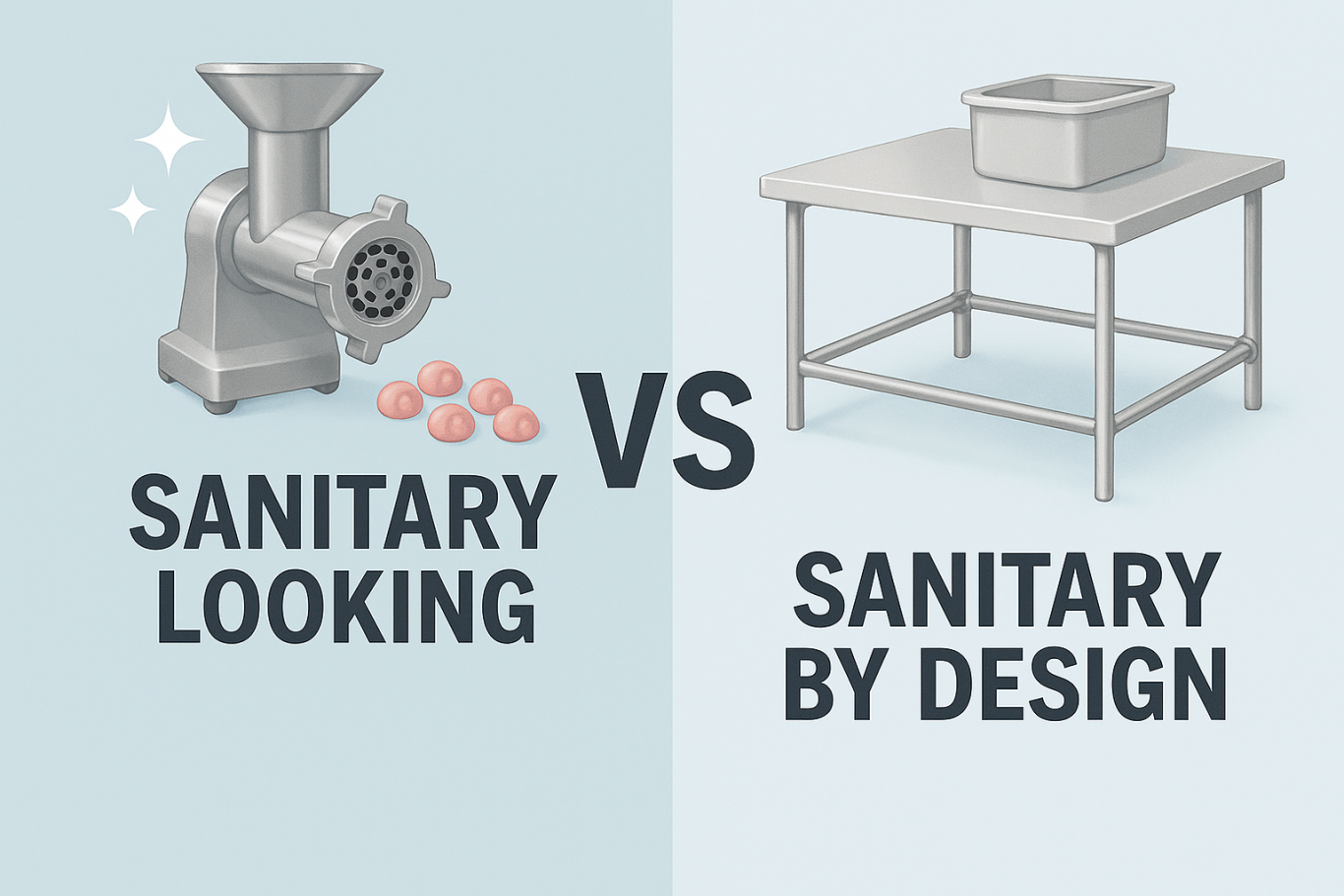
Sanitary looking vs Sanitary by design
There’s a big difference between “sanitary-looking” and sanitary by design.
If a piece of equipment still relies on gearboxes full of oil sitting overhead, bearings that need constant lubrication, or “food-safe” grease inches from your product zone — is it really sanitary? Let’s be honest — even “food-grade lubricants” are still chemicals. The only difference is that regulatory agencies have decided we can tolerate small amounts of them in our food. But is “a little contamination” ever acceptable in a process built on safety, quality, and trust? If the understanding is that there are no options then of course, food grade lubricants are better than traditional lubricants, but the reality in 2025 is that there are multiple options on the marked that replace food grade lubricants. High performance dry lube bearings, IP69k Direct drive permanent magnet motor options, even just updated designs that can now be made through CNC that traditional manufacturing hasn't been able to do in the past. All of these options come at a cost, but is it really okay to say that im not comfortable paying 5% more for a system just to ensure that my kids don't eat a few chemicals. To me personally that is one of the reasons I started this whole project. Hyper Klean isnt a business, its a philosophy that has a goal to increase food safety. That starts with proper selection of material and components that does not just mitigate the risk, it eliminates it. This has to start with the lubricants we use just to keep things moving.
Every year, hundreds of food recalls are linked to contamination from poorly maintained mechanical systems — leaking seals, gearbox oil drips, or lubricant overspray. These failures often go unnoticed until they trigger a costly recall. In 2024 alone, the FDA and USDA recorded 296 food recalls, with contamination from foreign materials and lubricants among the contributing factors. While many of these incidents never make headlines, the financial impact is staggering: industry studies estimate the average direct cost of a food recall exceeds $10 million, and nearly a quarter of recalls surpass $30 million when factoring in legal fees, lost sales, and reputational damage. Even a mid-sized recall involving fewer than 250,000 units can cost over $2 million in less than two weeks.
The good news? These risks are largely preventable. True sanitary design doesn’t stop at rounded frames, stainless steel material, or quick-release belts. It considers every component, every interface, and every potential contamination point — especially motion systems. Traditional gear-driven setups introduce multiple failure points: seals, bearings, and oil reservoirs that can leak under stress. Today, direct-drive technologies offer a compelling alternative by eliminating gearboxes and lubricants entirely — no oil, no external seals, no contamination risk. With traditional motion solutions regular seal inspections, predictive maintenance, and condition monitoring only reduce the likelihood of leaks and contamination. They do not eliminate it.
Next generation sanitary design principles should be looking toward elimination rather than mitigation. Smooth, corrosion-resistant surfaces, hermetically sealed hollow areas, and easy-to-clean assemblies prevent microbial harborage and lubricant pooling, but again dont eliminate the hazards completely. When you combine preventive engineering and truly hygienic component selection, these measures go beyond just protecting consumers. They create a shield that protects OEM companies and Food Production facilities from the financial and reputational fallout of recalls. In short, investing in advanced motion systems and robust Hyper Klean designs is more that just compliance — it’s a strategic safeguard against multi-million-dollar losses. When you factor in reduced contamination risk, lower maintenance, and the safety of your product and people, the real question becomes:
👉 If we are truly serious about food safety, when will we stop calling “less dirty” sanitary?