
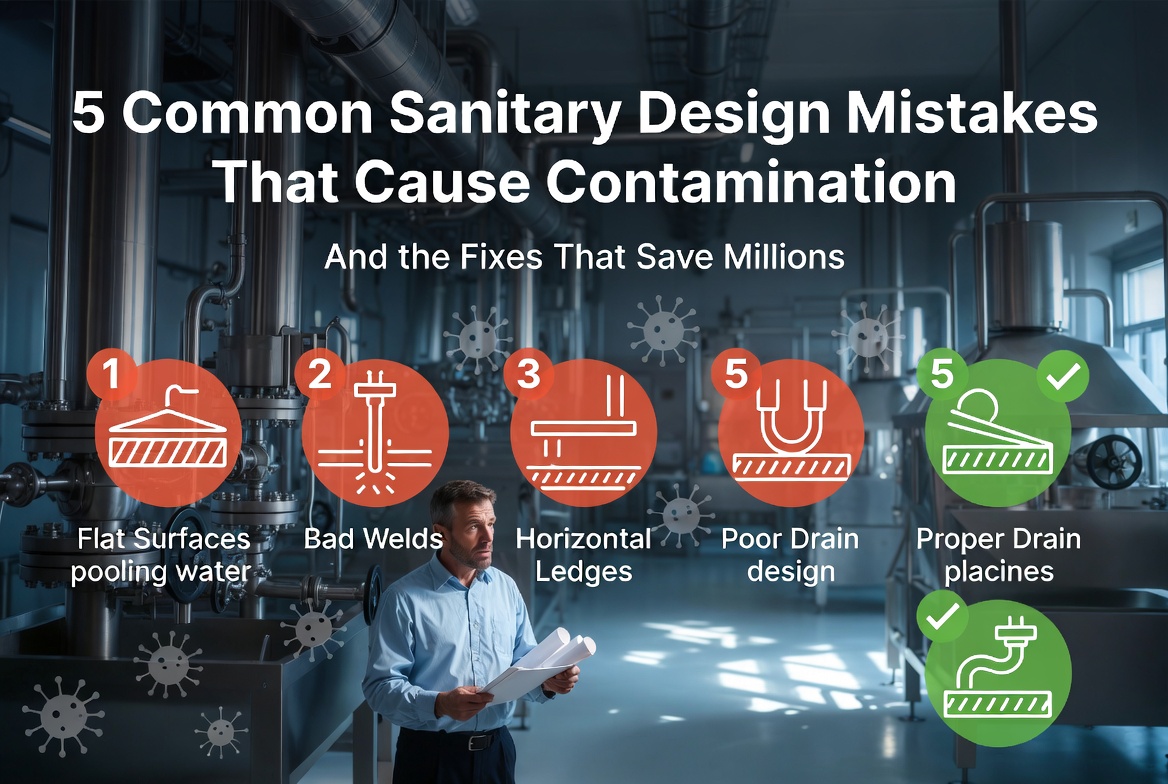
5 Common Sanitary Design Mistakes That Cause Contamination (And the Fixes That Save Millions)
In the high-stakes world of food production, a single contamination event traced to equipment can trigger a recall that wipes out millions in revenue, damages brand trust, and puts consumers at risk. Industry patterns show that bacterial contamination, particularly from persistent pathogens like Listeria monocytogenes and Salmonella, often stems directly from preventable flaws in the equipment itself. These issues hide in plain sight on production lines where 20 to 30 year old equipment built to nonexistent sanitary standards runs right next to newer clean looking designs that still fall short.
Failure to plan is just planning to fail. Yet many plants have been forced to adopt a “don’t look” mentality. In the past, dedicated on staff engineers walked the production floors every day, spotting issues that others preferred to avoid. They knew that if you go looking for something, you will most likely find it. True sanitary design flips the script: by building hygiene into every piece of equipment from the ground up, we minimize the chance of hidden problems dramatically, reducing the need to look because the risks simply are not designed in.
Here are the five most common equipment design mistakes that lead to contamination, along with real world impacts drawn from widespread recall patterns and the straightforward fixes that protect your operation and your bottom line.
1. Hollow Tube Frames and Structural Members with Cracked or Incomplete Welds Legacy equipment from 20 to 30 years ago commonly used hollow stainless tubing for frames, legs, and supports, designs that were never held to modern sanitary standards. Over time, micro cracks form at welds, especially where vibration and thermal cycling occur. Moisture and food residue seep inside these hollow sections, creating invisible harborage zones where Listeria and other pathogens form biofilms that routine cleaning cannot reach. Newer clean looking equipment often repeats the same mistake with partial welds or unsealed ends, allowing the same hidden contamination to spread to product contact surfaces.
This single design flaw has been a recurring factor in major recalls of ready to eat foods, where pathogens persisted inside equipment structures and contaminated entire production runs.
The Fix: Specify fully sealed, continuously welded tubular designs with sloped or capped ends that eliminate internal voids entirely. Use solid bar stock or properly radiused, fully penetrated welds on all structural components. When plants replace or retrofit with these standards, harborage sites disappear, cleaning validation becomes reliable, and recall risk drops sharply.
2. Threaded Fasteners, Bolts, and Rivets Instead of Hygienic Joints Old equipment is riddled with exposed threads, hex bolts, and rivets, fasteners that were acceptable decades ago but now serve as perfect bacterial traps. Food particles lodge in the threads, and cleaning solutions never fully penetrate. Even newer equipment sometimes retains clean looking bolted assemblies for cost reasons, creating the same crevices right alongside legacy machines.
These fastener related niches are a top contributor to persistent environmental contamination that leads to costly recalls involving millions of pounds of product.
The Fix: Design all connections with smooth, fully welded joints or quick release, tool free hygienic clamps and standoffs. Eliminate exposed threads completely. Equipment built this way disassembles in minutes for full inspection, turning what used to be a multi hour deep clean nightmare into a fast, verifiable process that prevents cross contamination between old and new lines.
3. Pneumatic Air Lines, Hoses, and Filters with Leaks or Missing Elements Compressed air systems on older equipment frequently feature rubber hoses, quick connect fittings, and filter regulator assemblies that were never designed for sanitary washdown. Cracks develop at connections, filters go unchanged for years, and condensate builds up inside lines. A single leak can aerosolize pathogens directly onto product zones. Newer clean looking lines often look better on the surface but still use non hygienic fittings or skip proper filter maintenance schedules.
Leaking or unfiltered air systems have been directly linked to widespread contamination events, driving recalls that cost companies millions in lost product and downtime.
The Fix: Install sanitary grade stainless air lines with welded or hygienic compression fittings, sloped for complete drainage, and equipped with double stage filter dryer units that are easily accessible and clearly labeled for routine replacement. Add automatic drain valves and moisture traps designed for daily blow down. These upgrades eliminate aerosol risks and keep air systems as clean as the product they touch.
4. Non Rounded Corners, Sharp Internal Angles, and Crevice Ridden Components Equipment built to yesterday’s standards often features 90 degree internal corners, square tubing transitions, and press fit panels that leave microscopic gaps. Even modern clean looking designs sometimes cut corners here to save on fabrication costs, creating the same hard to clean zones where residue accumulates and biofilms thrive, especially when old and new machines share the same production floor.
These geometric flaws turn routine sanitation into an impossible task and are a frequent root cause of equipment driven recalls.
The Fix: Mandate minimum one quarter inch radii on all internal and external corners, continuous welds, and fully drainable geometries. Use self draining, sloped surfaces throughout. Equipment engineered to these exacting standards cleans faster, validates easier, and prevents the migration of contaminants from legacy machines to newer ones.
5. Incompatible or Substandard Materials and Surface Finishes Older equipment often incorporates carbon steel components, porous castings, or low grade stainless that corrodes under repeated chemical exposure. Newer clean looking machines may use 304 stainless where 316 is required or apply finishes that pit over time. Mixed lines create galvanic corrosion risks and surface imperfections that become new harborage points.
Material degradation has repeatedly allowed biofilms to take hold, contributing to large scale contamination recalls and forcing unplanned equipment replacements at massive cost.
The Fix: Standardize on food grade 316 stainless or higher with number 4 or better electropolished finishes, non porous components, and corrosion resistant alloys matched to your specific cleaning chemistry. Require material certificates and surface roughness specifications at the design stage. This ensures every piece of equipment, old or new, performs to the same hygienic level for decades.
Plants that once relied on on staff engineers constantly hunting for problems are now discovering that the best defense is not more inspections but better equipment design from day one. By addressing these five equipment specific mistakes upfront, forward thinking facilities prevent the “don’t look” culture altogether. They replace reactive firefighting with proactive confidence, knowing their sanitary design minimizes contamination risk at the source, even when 20 to 30 year old machines still run alongside newer lines.
The numbers speak for themselves: recalls tied to preventable equipment design flaws routinely cost companies millions in direct losses, legal fees, and reputational damage. Investing in true sanitary equipment design is not an expense but the ultimate cost saving strategy. Failure to plan is just planning to fail. The good news? The fixes are proven, accessible, and deliver returns far beyond the initial investment.
At Hyper Klean, we specialize in helping food manufacturers upgrade their equipment to true sanitary standards that eliminate these risks at the source. Our team works directly with you to audit existing lines and design or retrofit solutions that deliver lasting hygiene and peace of mind.
If your operation is ready to move beyond the “don’t look” approach and build contamination resistance into every piece of equipment, now is the time. The engineers who once walked the floors searching for trouble would approve: the smartest plants are not looking for problems, they have already designed them out of existence.