
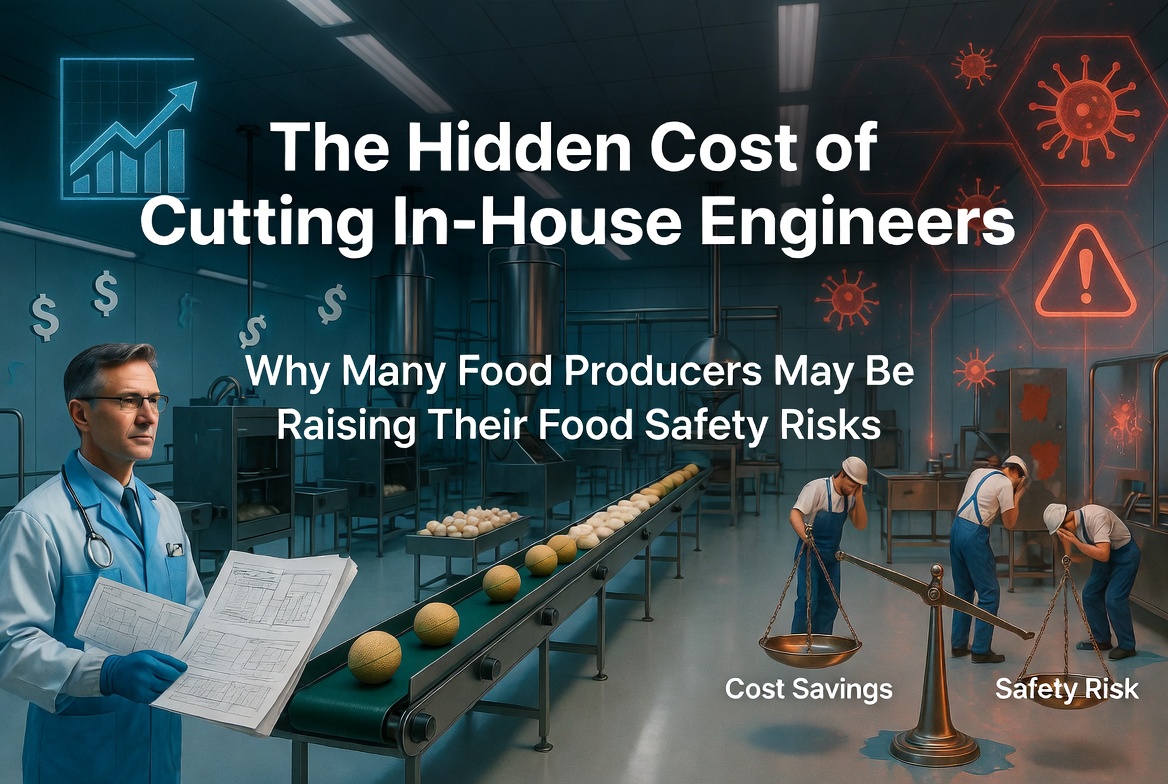
The Hidden Cost of Cutting In-House Engineers: Why Many Food Producers May Be Raising Their Food Safety Risks
Food production companies operate under constant pressure to control costs, protect margins, and stay competitive in a challenging market. One area that has drawn attention in recent years is the reduction of dedicated engineering staff—process engineers, hygienic design specialists, and food safety engineers.
Many processors have scaled back or eliminated these full-time roles, often shifting responsibilities to maintenance or operations teams. The thinking frequently centers on lowering fixed overhead while keeping production running smoothly. Yet this shift can gradually reduce specialized oversight of critical areas like hygienic engineering and HACCP systems.
Food recalls have shown an overall upward trend in recent years. Reports indicate the total number of recalls rose from around 505 in 2021 to 613 in 2025, with the most serious (Class I) recalls increasing notably. In some periods, the volume of recalled units has also climbed significantly. The average direct cost of a recall is often cited in the range of $10 million, though indirect impacts—such as lost sales, brand damage, and legal expenses—can multiply that figure several times over. Broader estimates place the annual economic burden of unsafe food in the tens of billions of dollars in the U.S.
This article explores why some companies reduce engineering roles, the potential implications for food safety, why relying solely on maintenance and operations for engineering decisions can be challenging, and how independent expertise might help fill gaps. It also touches on real-world examples and considerations for long-term risk management.
Why Companies Sometimes Reduce In-House Engineering Staff
Decisions to trim engineering positions often stem from several common factors:
• Cost management: A senior food safety or process engineer typically carries a significant fully loaded cost. In industries with tight margins, reducing fixed salaries and benefits can appear attractive on financial statements.
• Lean operations philosophy: Many organizations have adopted approaches that emphasize doing more with fewer dedicated specialists, assuming day-to-day teams can manage technical needs when lines are running.
• Broader workforce adjustments: Large food companies have announced sizable global reductions, including white-collar and technical roles. For instance, Nestlé outlined plans to cut approximately 16,000 positions worldwide, with a substantial portion affecting office-based and management functions alongside some manufacturing and supply chain roles. Similar pressures have been reported across other major players facing profitability challenges.
• Outsourcing trends and talent dynamics: Just as some functions like sanitation have been outsourced, engineering can feel like an area where external support might substitute for full-time staff. Retaining specialists with deep knowledge of both regulations and hygienic design can also be difficult in a competitive labor market.
These moves can make sense in the short term for financial flexibility. However, they risk creating gaps in specialized technical knowledge that supports ongoing food safety.
The Importance of Hygienic Engineering and HACCP Ownership
HACCP (Hazard Analysis and Critical Control Points) serves as a foundational food safety system. It goes beyond documentation to require a solid grasp of process flows, equipment design, material choices, and potential points where pathogens or contaminants could take hold.
Dedicated engineers often bring focused ownership to hygienic design elements, such as:
• Selecting and configuring equipment with features like sloped surfaces, cleanable welds, avoidance of dead legs, and fully drainable lines.
• Designing facility layouts that support proper zoning, traffic flow, and air handling to minimize cross-contamination risks.
• Validating cleaning and sanitation procedures under actual plant conditions.
• Monitoring for new or evolving risks, including regulatory updates, allergens, or emerging pathogens.
When in-house engineering capacity is reduced, companies may lose some of that institutional depth and the ability to evaluate decisions through a consistent technical lens.
Challenges of Shifting Engineering Decisions to Maintenance and Operations
Maintenance and operations teams play vital roles in keeping plants productive and efficient. Their priorities, however, differ from those of specialized engineers:
• Maintenance staff often focus on rapid repairs and maximizing equipment uptime. They may not have extensive training in hygienic design standards (such as those from 3-A, EHEDG, or AMI) or in conducting formal risk assessments for cleanability.
• Operations teams are typically measured on output, yield, and throughput. This can create pressure to keep lines moving, sometimes leading to acceptance of temporary fixes or modifications that prioritize speed over long-term sanitary performance.
Without dedicated engineering input, small compromises—such as equipment patches, altered cleaning routines, or layout adjustments—can accumulate. Over time, these may increase the chance of issues like harborage points for bacteria, allergen carryover, or post-process contamination. Neither group is usually positioned to stay fully current on evolving regulatory expectations under FSMA or other standards.
Lessons from Past Incidents
Certain historical outbreaks illustrate how equipment and facility design factors can contribute to contamination events. While every situation is unique, these cases highlight the value of strong technical oversight.
In the 2011 Jensen Farms cantaloupe Listeria outbreak, which affected many people and resulted in numerous fatalities, investigators pointed to the packing facility’s use of equipment originally designed for potatoes. The machinery was difficult to clean thoroughly, showed signs of corrosion and buildup, and the overall setup allowed water to pool in areas near product contact surfaces. Facility floors and drains also presented cleaning challenges. Proper hygienic equipment evaluation and validation might have identified these issues earlier.
The Blue Bell Creameries Listeria incidents around 2015 involved multiple plants and led to a full recall, temporary shutdowns, and tragic outcomes. FDA observations noted Listeria in drains and on equipment, condensation dripping onto surfaces, and design elements (such as gaskets and piping) that complicated thorough cleaning and disassembly. The company had detected positives in prior years but faced ongoing challenges addressing root causes in equipment and facility conditions. Enhanced engineering focus on sanitary design and validation could have helped mitigate such risks.
These examples suggest that when technical expertise in hygienic engineering is limited, vulnerabilities can go unaddressed until they surface through testing or incidents.
Considering Outsourced or Independent Engineering Support
Reducing full-time engineering staff does not necessarily mean forgoing expert input. Many companies explore partnerships with independent consulting engineers or specialized food safety engineering firms as a flexible alternative.
Potential benefits include:
• Access to expertise on an as-needed basis, avoiding constant overhead.
• Exposure to practices from a wide range of facilities, which can help identify blind spots.
• Specialized support for hygienic design reviews, process validation, HACCP updates, or capital projects.
• Scalability during new line installations, facility upgrades, or periods of heightened regulatory focus.
• Clear documentation that can support audits and decision-making.
Some processors maintain a small internal lead while contracting deeper technical work to independents. This hybrid approach can provide robust engineering support without the full cost of a large in-house team.
Why Risk Can Seem Manageable—Until It Isn’t
In the absence of immediate problems, reduced engineering capacity may not raise obvious red flags. Plants often operate for extended periods without major incidents, reinforcing the perception that current arrangements are sufficient.
Food safety events, however, tend to be low-frequency but high-impact. When issues do emerge, questions quickly arise about equipment approvals, HACCP updates, and validation records. At that stage, companies may need to rapidly rebuild technical capabilities under significant pressure and scrutiny.
The Case for Proactive Ownership
Delaying stronger engineering oversight until after an incident can carry substantial consequences:
• Impacts on worker health through potential exposure to contaminants or challenging sanitation conditions.
• Financial strain from product losses, downtime, regulatory actions, and higher insurance costs.
• Damage to brand trust, which can be difficult and expensive to rebuild in an era of rapid information sharing.
Organizations that view hygienic engineering as integral to operations—rather than purely discretionary—often position themselves better for sustained performance.
How Hyper Klean Can Support Engineering Functions
At Hyper Klean, we specialize in helping food processors strengthen their sanitation and hygienic practices. We understand the pressures on internal teams and offer flexible support that can complement or extend engineering efforts—whether through targeted assessments, validation assistance, or guidance on cleanable systems. Our goal is to help companies reduce risks in practical ways without adding unnecessary burden. If your operation is navigating changes in technical resources, we’re happy to discuss how our services might align with your needs.
Looking Ahead
Reducing in-house engineering roles can provide short-term financial breathing room, but it may shift important food safety responsibilities in ways that deserve careful consideration—particularly as recall trends and complexity continue to evolve.
Many processors are finding value in hybrid models that blend lean internal structures with strategic external expertise. By treating hygienic engineering thoughtfully, companies can better protect their people, products, and reputation.
The realities of food production mean risks are always present. Addressing them proactively, through whatever combination of resources makes sense for your operation, tends to be far less costly than reacting after the fact. If you’re evaluating your approach to these challenges, exploring supportive partnerships could be one more practical step worth considering.